Ancient Civilizations of Mexico: 10 Fascinating Facts You Never Knew
The ancient civilizations of Mexico are among the most advanced and mysterious in human history, stretching back thousands of years before the first Europeans arrived. While many people are familiar with the famous Egyptian pyramids, Mexico is actually home to a “cradle of civilization”—one of only six places in the entire world where complex societies developed all on their own. From the jungle-shrouded temples of the Maya to the massive island capital of the Aztecs, these cultures were masters of math, astronomy, and engineering.
In fact, our understanding of these empires is changing every single day. Just as recently as late 2024 and early 2025, archaeologists using high-tech lasers discovered an enormous, “lost” Maya city named Valeriana hiding in plain sight beneath the jungle canopy. This proves that there is still so much to learn about the incredible people who built these cities.
In this guide, we’re going to dive into 10 mind-blowing facts that show why the history of ancient Mexico is even more impressive than what you might find in a standard textbook.
Ancient Civilizations of Mexico: 10 Fascinating Facts You Never Knew
1. The World’s Largest Pyramid isn’t in Egypt
When you think of massive pyramids in ancient civilizations of Mexico, your mind probably goes straight to the Great Pyramid of Giza. However, the largest pyramid on Earth by volume is actually found in the state of Puebla, Mexico. Known as the Great Pyramid of Cholula (or Tlachihualtepetl), this monument holds the official Guinness World Record for the largest pyramid ever constructed by humans.
What makes this one of the most interesting facts about the ancient civilizations of Mexico is that if you visited it today, you might mistake it for a natural hill. Because it was built using mud bricks (adobe), layers of dirt and vegetation grew over it over centuries. To make things even more surreal, there is a colonial-era church, the Santuario de Nuestra Señora de los Remedios, sitting right on top of the structure.
While it is not as tall as its Egyptian cousins, its base is a staggering four times larger than Giza’s. Today, you can actually walk through a portion of the extensive archaeological tunnels that were excavated inside the pyramid to study its many layers of construction.
2. “Valeriana”: The Massive City Discovered in 2024
One of the most exciting things about the ancient civilizations of Mexico is that we are still finding massive cities today! In late 2024, researchers announced the discovery of a sprawling Maya metropolis named Valeriana, hidden beneath the jungle in the state of Campeche. Remarkably, it wasn’t found through a jungle expedition, but by a PhD student who was analyzing a laser survey that had been published online for environmental research years ago.
Using a technology called LiDAR (Light Detection and Ranging), which uses lasers to “see” through thick trees and map the ground below, scientists identified over 6,500 structures that had been “lost” for centuries. This city was so large that experts believe it was once home to between 30,000 and 50,000 people at its peak—more than the number of people living in that same area today.
The city featured two major centers with huge temple pyramids, ball courts, and even a reservoir for storing water. As noted by Smithsonian Magazine, this massive site was “hidden in plain sight,” located just a 15-minute walk from a major modern highway. This discovery proves that the Maya civilization was far more populated and urbanized than historians once thought.
3. The Aztecs Had Compulsory Education (For Everyone)
While many people imagine the ancient civilizations of Mexico as strictly warrior cultures, they were actually pioneers in public education. Long before many European countries established public school systems, the Aztecs (the Mexica) required every child to attend school, regardless of their gender or social status. This was a revolutionary idea at the time!
According to educational resources from History on the Net, and History Crunch there were two main types of schools that children would attend starting around age 15:
The Telpochcalli: These schools were located in every neighborhood and were primarily for the commoners. Students here focused on history, religion, and military training, learning how to serve their community and empire.
The Calmecac: These were more rigorous schools, usually reserved for the children of nobles. Here, students learned advanced subjects like astronomy, law, government, and the complex art of the sacred calendar.
Even more impressive is that girls were also educated. While their training often focused on specialized roles like priestesses, doctors, or skilled artisans, the fact that the state ensured every child was literate in their culture and history was incredibly advanced. They even had a school called the Cuicacalli, or “House of Song,” where everyone learned the ritual songs and dances that kept their society connected.
4. The Olmecs: The “Rubber People”
Long before modern companies started making tires and sneakers, the ancient civilizations of Mexico had already mastered the science of rubber. The Olmec civilization, which is often called the “Mother Culture” of Mexico, lived in the tropical lowlands of the Gulf Coast. In fact, their very name—Olmec—is an Aztec word that literally translates to “the rubber people.”
The Olmecs discovered that they could take the milky sap (latex) from the Castilla elastica tree and mix it with the juice of a specific vine called the morning glory. This wasn’t just a simple mix; it was a complex chemical process. Scientists from MIT discovered that by changing the amount of morning glory juice, the Olmecs could create different types of rubber for different uses!
For Games: A 50-50 mix created a highly bouncy rubber perfect for the famous Mesoamerican ballgame.
For Tools: A 75-25 mix created a tougher, more durable rubber used for making sandals and even adhesives to keep tools together.
This incredible invention happened around 1600 BC—nearly 3,500 years before Charles Goodyear “invented” vulcanized rubber in the 1800s. You can read more about the science behind this ancient chemistry at the official MIT research site.
5. Teotihuacán: The “Place of the Gods” was an Abandoned Mystery
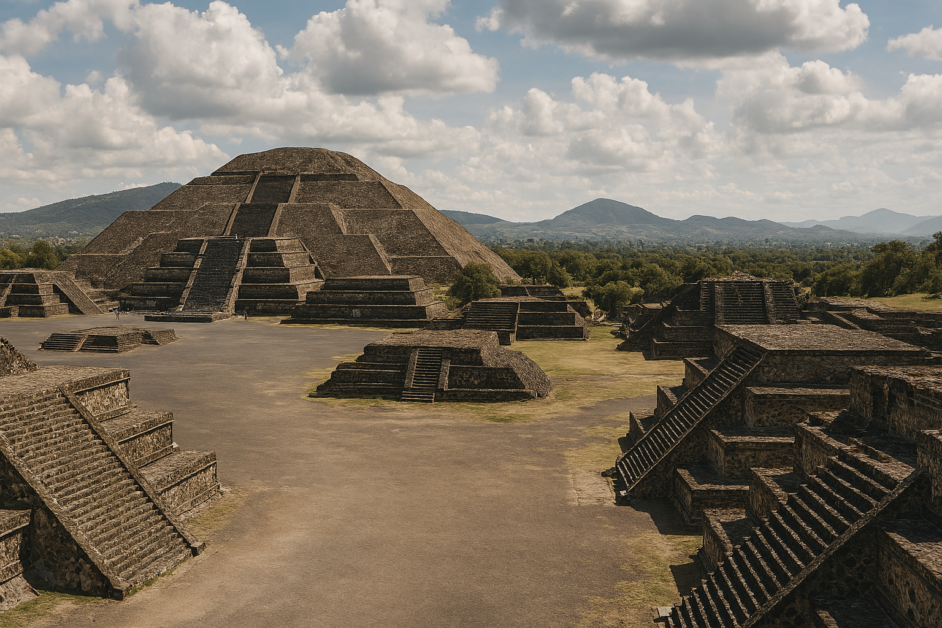
One of the most iconic sites among the ancient civilizations of Mexico is Teotihuacán, home to the massive Pyramid of the Sun and the Pyramid of the Moon. However, here is the real mystery: when the Aztecs first discovered this city in the 1300s, it had already been abandoned for nearly 700 years!
No one knows exactly who built Teotihuacán or what they called themselves. The name “Teotihuacán” is actually an Aztec word that means “the place where the gods were created.” The Aztecs were so awestruck by the size of the pyramids—which were the largest structures in the Americas at the time—that they believed only gods could have built them.
At its peak around 500 AD, Teotihuacán was a multicultural metropolis with a population of over 125,000 people, making it one of the largest cities in the world. It was a hub for trade, especially for obsidian (volcanic glass), which was used to make the sharpest tools and weapons in the ancient world.
Today, archaeologists are still uncovering secrets beneath the city. In recent years, a hidden tunnel was discovered under the Temple of the Feathered Serpent containing thousands of ritual objects, including greenstone statues and even pools of liquid mercury. You can explore the details of these groundbreaking finds in this deep dive from Smithsonian Magazine.
6. The Maya Invented the Concept of “Zero”
Imagine trying to do math without the number zero. It sounds impossible, right? While many ancient civilizations of Mexico and the rest of the world were great at counting, the Maya were among the very few in history to independently invent the mathematical concept of zero. This was a massive breakthrough that happened hundreds of years before the concept even reached Europe!
The Maya used a “base-20” system (likely because we have ten fingers and ten toes). In this system, zero wasn’t just “nothing”—it was a crucial placeholder that allowed them to write incredibly large numbers and perform complex calculations. This math was the secret behind their famously accurate calendars, which could track the movements of the stars and planets for thousands of years into the future.
In their writing, the Maya usually represented zero with a symbol that looked like a cacao bean or a stylized shell. Sometimes, they even used a picture of a hand holding a shell to mean “completion.” You can see examples of how they used these symbols in their ancient books, called codices, at the Britannica Kids educational portal.
7. Popcorn and Chocolate: Ancient Mexican Gifts to the World
If you love snacking during a movie, you have the ancient civilizations of Mexico to thank! Two of the world’s most popular treats—chocolate and popcorn—have deep roots in ancient Mesoamerica.
The “Food of the Gods” (Chocolate)
The history of chocolate began with the Olmecs and Maya, who were the first to ferment, roast, and grind cacao beans. However, they didn’t eat it in bars; they drank it as a bitter, frothy beverage often mixed with chili peppers and vanilla. The Aztecs later called this drink xocolatl. Cacao was so valuable that it was used as currency—you could actually buy a forest rabbit for 10 cacao beans!
Direct Source: Smithsonian Magazine – A Brief History of Chocolate
The “White Flowers” (Popcorn)
Popcorn is another ancient invention. When the Spanish explorer Hernán Cortés first arrived in Mexico, he saw the Aztecs using “parched corn” that burst into what looked like “white flowers.” The Aztecs called it momochitl. They didn’t just eat it; they used it as garlands for dancing and to decorate statues of their gods, like Tlaloc, the god of rain.
Direct Source: Popcorn.org – The History of Popcorn
8. The “Superhighways” of the Jungle (Sacbeob)
Long before modern highways, the Maya were master roadbuilders. They constructed a vast network of elevated stone roads called sacbeob (plural for sacbe), which literally means “white roads”. These weren’t just simple dirt paths; they were sophisticated engineering marvels that connected entire cities.
What made these roads so special was their construction. They were raised anywhere from a few feet to over six feet above the jungle floor and paved with a smooth layer of white limestone plaster. Historians believe the Maya chose this white color for a very clever reason: it reflected the moonlight, allowing travelers to walk between cities at night to avoid the sweltering tropical sun.
Engineering Feat: Some of these roads, like the one connecting the ancient cities of Coba and Yaxuna, stretched for over 60 miles (100 kilometers) in a nearly perfectly straight line!
Purpose: Since the Maya did not have pack animals or wheeled vehicles, these “superhighways” were used by merchants carrying heavy loads on their backs, as well as for religious processions and royal messengers.
You can still see a famous sacbe today if you visit Chichén Itzá; it’s the wide path that leads from the main pyramid directly to the Sacred Cenote.
9. Tenochtitlan: The “Venice of the West”
The capital of the Aztec Empire, Tenochtitlan, was one of the most incredible cities ever built. When the Spanish arrived in 1519, they were shocked to find a massive metropolis of over 200,000 people built right in the middle of a lake! Because it was surrounded by water and connected by a network of canals, many historians call it the “Venice of the Americas.”
Building a city on a lake was an engineering masterpiece. The Aztecs created a system of chinampas, or “floating gardens.” These were man-made islands created by layering mud and vegetation, which allowed them to grow crops directly on the lake. These gardens were so productive that they could provide enough food for the entire city.
Cleanliness: While many European cities at the time struggled with sanitation, Tenochtitlan was famous for being incredibly clean. They had a dedicated team of workers who swept and washed the streets every single day.
Aqueducts: To ensure a steady supply of drinking water, the Aztecs built sophisticated stone aqueducts that transported fresh water from springs miles away on the mainland directly into the heart of the city.
Today, the ruins of this magnificent island city lie directly beneath the modern streets of Mexico City. You can still visit the remains of the Templo Mayor, the main temple of the Aztecs, right in the center of the city’s historic district.
10. The Mystery of the Colossal Olmec Heads
The ancient civilizations of Mexico reached a peak of artistic power with the Olmec, the “mother culture” that predates both the Maya and the Aztecs. Their most famous legacy is a collection of 17 massive stone heads carved from solid basalt. These sculptures are not just large; they are monumental, with the largest standing over 11 feet tall and weighing as much as 40 to 50 tons!
The real mystery that boggles the minds of scientists is how they got there. The basalt stone used for the heads was quarried in the Tuxtla Mountains—over 60 miles away from where they were eventually placed. Because the Olmecs did not have the wheel or large animals like oxen to pull heavy loads, they had to move these 20-ton boulders through thick swamps and across wide rivers using nothing but human strength, wooden rollers, and massive rafts.
Individual Portraits: Archaeologists believe these aren’t just random faces or gods. Each head has distinct facial features—like unique expressions, wrinkles, and even “dimples”—suggesting they are realistic portraits of powerful Olmec rulers.
The “Helmets”: Every head wears a unique headdress that looks remarkably like a modern football helmet. Some historians think these represent protective gear worn during the ritual ballgame, while others believe they were royal crowns decorated with animal symbols like jaguar paws or bird feathers.
These stoic, stone giants have survived for over 3,000 years, acting as silent guardians of a culture that laid the foundation for everything that followed in Mexican history,
Conclusion
The ancient civilizations of Mexico were far more than just builders of ruins; they were scientists, mathematicians, engineers, and artists whose influence is still felt today. From the chocolate we eat to the mathematical “zero” we use in school, their legacy is woven into our daily lives. As modern technology like LiDAR continues to peel back the jungle canopy, we are likely to find even more “lost cities” and incredible secrets in the years to come.
Which of these 10 facts surprised you the most? Whether it’s the massive “hidden” pyramid or the fact that Aztec kids had to go to school, there is always something new to discover about Mexico’s past. We hope you enjoyed our article on the ancient civilizations of Mexico. Now check out our article on the story behind the Mexican flag.
Frequently Asked Questions
Q. Which was the oldest civilization in Mexico?
A. The Olmec civilization is considered the "Mother Culture" of Mexico. They flourished along the Gulf Coast from approximately 1600 BC to 400 BC. They were the first to build major religious centers and develop the complex calendar systems that later cultures like the Maya and Aztecs would perfect.
Q. Why did the Maya civilization collapse?
A. There wasn't just one single reason. Most archaeologists believe a combination of long-term droughts, deforestation, and overpopulation led to the abandonment of the Great Southern Lowland cities. However, the Maya people never disappeared; millions of Maya descendants still live in Mexico and Central America today, speaking their ancestral languages.
Q. Is it true that the Aztecs thought the Spanish were gods?
A. This is a common myth, but modern historians have largely debunked it. Most evidence suggests the Aztecs were initially curious about the Spanish and their horses (which they had never seen), but they quickly realized the Spaniards were mortal men. The "god" story was popularized later in colonial accounts to justify the conquest.
Q. Can you still visit the ancient ruins mentioned in this article?
A. Yes! Most of these sites are protected by the National Institute of Anthropology and History (INAH) and are open to the public. You can climb some of the structures at Cholula, walk the "Avenue of the Dead" at Teotihuacán, and explore the famous temples of Chichén Itzá and Palenque.
Q. How do scientists find cities like “Valeriana” if they are covered in jungle?
A. Today, scientists use a tool called LiDAR (Light Detection and Ranging). By flying a plane or drone over the forest and firing millions of laser pulses at the ground, they can map the surface beneath the trees. This "digital deforestation" reveals the shapes of pyramids, roads, and houses that are otherwise invisible to the human eye.