The Ultimate Guide on the Tipping Etiquette in Mexico: 10 Essential Rules To Follow
The Ultimate Guide on the Tipping Etiquette in Mexico
Mastering the tipping etiquette in Mexico is one of the most important skills you can pack for your trip, alongside your passport and sunscreen. Known locally as la propina, tipping is deeply woven into the social and economic fabric of the country. While it is technically voluntary, it is a vital part of how service workers—from the person bagging your groceries to the waiter at your favorite beachside bistro—earn a livable income.
In 2026, the importance of this practice remains high. Even though Mexico has implemented significant minimum wage increases (rising to approximately $315.04 pesos per day for most of the country), many service roles still rely on the generosity of travelers to supplement their base pay. Understanding the “who, when, and how much” ensures you show respect for the local culture and the hard-working individuals who make your vacation memorable.
Why Tipping Matters
The “Propina” Culture: In many sectors, tips are not just a “bonus” but a primary source of income.
Social Harmony: Following local norms helps you avoid awkward social situations and ensures high-quality service throughout your stay.
Legal Protections: It is important to know that while expected, PROFECO (Mexico’s consumer protection agency) explicitly states that tips cannot be mandatory or automatically included in your bill without your consent.
Rule 1: Always Tip in Pesos, Not Dollars
While many tourist destinations in Mexico will technically accept U.S. Dollars (USD) or Canadian Dollars (CAD), tipping in local currency is far more helpful to the recipient. When you tip in a foreign currency, the service worker must eventually visit a bank or a casa de cambio (exchange house) to convert those funds into Mexican Pesos (MXN). This often results in them losing a percentage of your gift to poor exchange rates or transaction fees.
Furthermore, recent regulations in Mexico have made it more difficult for locals to exchange foreign cash. According to experts at Mexperience, currency exchange houses now frequently require a passport to change even small amounts of foreign money—a document many service workers may not carry daily. To ensure your gratitude is fully felt, always keep a stash of pesos. If you do find yourself without local currency, Wise recommends using crisp, undamaged bills, as even a small tear can make a U.S. dollar bill impossible to exchange in Mexico.
Rule 2: Master the Restaurant Percentages (10% to 15%)
Dining out is where you will most frequently encounter the nuances of tipping etiquette in Mexico. As a general rule of thumb, a 10% tip is considered the baseline for standard service. If the service was good, 12% to 15% is the local norm, while 18% to 20% is reserved for truly exceptional experiences at high-end establishments.
The expectations can vary slightly depending on your location:
Casual Eateries (Fondas): In small, family-run spots, 10% is perfectly acceptable.
Tourist Zones & Fine Dining: In popular hubs like Tulum or Los Cabos, 15% is the standard expectation. Experts at AFAR note that while 20% is considered an excellent tip, over-tipping significantly beyond that can sometimes distort local economic dynamics.
Coffee Shops & Bars: For a quick espresso or a single round of drinks, a flat tip of 10–20 pesos is standard. If you are running a tab at a cocktail bar, sticking to the 10–15% range is recommended.
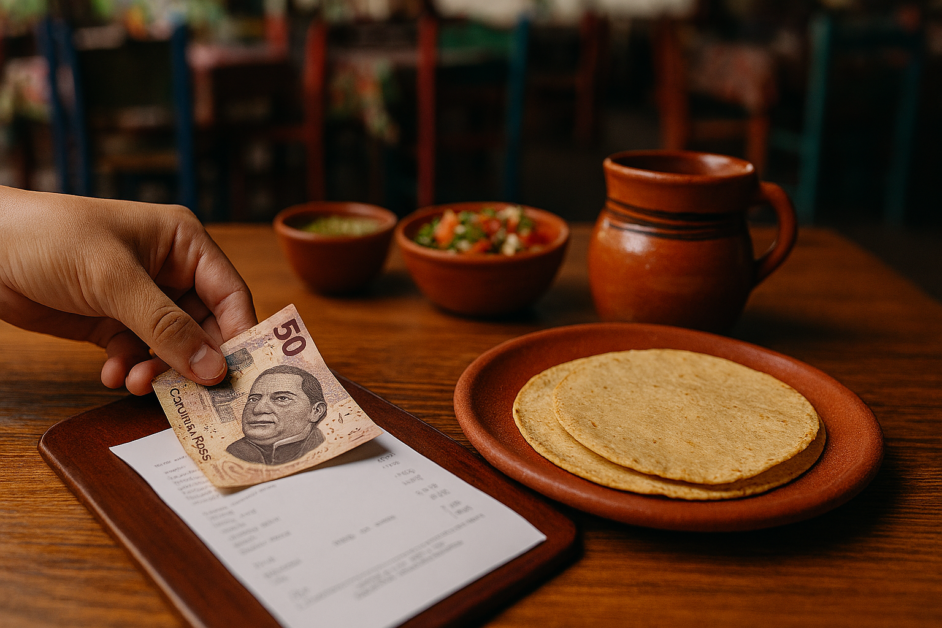
If you are paying by credit card, the server will usually bring a mobile terminal to your table and ask, “¿Gusta dejar servicio?” (Would you like to leave a tip?). You can then select a percentage or enter a manual amount. However, whenever possible, try to leave the tip in cash—this ensures the money goes directly into the server’s pocket rather than being processed through the restaurant’s payroll system weeks later.
Rule 3: Scan Your Bill for “Propina” or “Servicio”
Before you reach for your wallet, it is essential to review your bill (la cuenta) line by line. In many popular tourist destinations, some establishments have begun including a “service charge” or servicio automatically. While this is common practice in some parts of the world, it is actually a contentious issue in Mexico.
According to PROFECO (Mexico’s Federal Consumer Protection Agency), it is strictly illegal for a restaurant to mandate a tip or include it as a fixed charge on your bill without your express consent. In late 2025 and early 2026, the agency ramped up inspections, especially in areas like Tulum and Puerto Vallarta, to crack down on businesses that use “coercive methods” to collect tips.
How to Read Your Bill:
Subtotal: The cost of your food and drinks.
IVA (16%): This is the value-added tax. By law, this should already be included in the menu prices, though it is often listed as a separate line item for clarity.
Propina / Servicio: If you see this, a tip has already been suggested or added.
If you find a servicio charge on your bill and the service was mediocre, you have the legal right to ask for its removal. However, if the service was excellent and you see a 10% or 15% servicio added, you can simply pay that amount and consider the tip handled. Just be careful not to “double tip” by adding another 15% on top of a bill that already includes it! For more on your rights as a consumer, Mexperience provides a great breakdown of how to navigate these local “house policies” gracefully.
Rule 4: Tip Hotel Housekeeping Daily
Hotel housekeeping staff are among the hardest-working individuals in the travel industry, yet they are often the most overlooked when it comes to tipping etiquette in Mexico. Unlike a waiter who is visible throughout your meal, housekeeping staff often perform their duties while you are out exploring. To ensure they are fairly compensated, the standard practice is to leave between 30 to 50 pesos per day.
Why Daily Tipping is Key
Many travelers make the mistake of leaving one large tip at the end of a week-long stay. However, hotel staff often work on rotating schedules. If you wait until your final day, the person who meticulously cleaned your room for the first five days may not be the one on shift to receive the gratuity. By tipping daily, you ensure the specific person who serviced your room that day is the one who benefits.
Best Practices for Leaving the Tip
Where to Place It: Leave the cash in an obvious spot, such as on a pillow or the bedside table.
Include a Note: To avoid confusion (so the staff knows the money isn’t just loose change you forgot), it is helpful to leave a small note saying “Gracias” or “Para la camarera.”
Adjust for Mess: If you are traveling as a family or have left the room particularly untidy, increase the amount to 100 pesos to reflect the extra effort required.
Rule 5: Don’t Ignore the “Gasolineras”
In Mexico, gas stations (primarily the state-owned Pemex or private brands like Mobil and BP) are entirely full-service. You generally do not pump your own gas; instead, an attendant will greet you, ask which type of fuel you need (Magna for regular or Premium), and handle the transaction for you.
While these attendants are employed by the station, they often earn a very low base salary and rely on small tips from every car to make a living.
The Going Rate in 2026
Standard Fill-up: If the attendant simply pumps your gas and takes your payment, a tip of 5 to 10 pesos is the standard courtesy.
Extra Services: It is very common for attendants to offer to wash your windshield, check your oil, or verify your tire pressure while the tank fills. If they perform these extra tasks, you should increase your tip to 20 to 40 pesos.
A Pro-Traveler Safety Tip
When you pull up to the pump, always ensure the display is set to “0.00” before the attendant begins. While most attendants are honest, “not zeroing the pump” is a well-known travel scam in some areas. Experts recommend making eye contact and saying “Cero, por favor” (Zero, please) to ensure you are only paying for the fuel you actually receive.
Keeping a few 10-peso coins in your center console specifically for gas station stops is a great way to handle these quick interactions without fumbling for change.
Rule 6: Support the Grocery Baggers (Cerillos)
One of the most unique aspects of tipping in Mexico occurs at the grocery store checkout. You will notice people (often senior citizens or teenagers) bagging your items. Locally known as cerillos (little matches), these individuals are typically not employees of the store. Instead, they are volunteers who work exclusively for tips.
How Much to Tip
Small Load: If you only have a few items, a tip of 5 to 10 pesos is standard.
Full Cart: For a larger grocery haul, a tip of 20 to 30 pesos is more appropriate.
Help to Your Car: If the bagger helps you wheel your cart to the parking lot and loads the bags into your trunk, it is customary to tip 30 to 50 pesos depending on the weight and quantity of the items.
These volunteers play a significant role in the local informal economy. For many seniors, this is a vital way to remain active and supplement their pensions. It can feel quite awkward to realize you have no small change after someone has carefully packed your glass bottles and produce, so always try to keep a few coins or a 20-peso note handy before you reach the register.
Rule 7: Know When to Tip Your Driver (Taxi vs. Uber)
Navigating transportation is a daily task for most travelers, but the tipping etiquette in Mexico for drivers depends entirely on how you hailed the ride. In Mexico, the rules for traditional street taxis are quite different from modern ride-hailing apps.
Traditional Taxis
Unlike in the United States or Canada, it is not customary to tip taxi drivers in Mexico for a standard point-to-point ride. You simply pay the agreed-upon fare or the amount shown on the meter (taxímetro). However, there are two exceptions where a small tip is appropriate:
Luggage Assistance: If the driver helps you load and unload heavy suitcases, a tip of 10 to 20 pesos is a polite gesture.
Extra Services: If the driver waits for you while you run into a shop or provides local recommendations, rounding up the fare is appreciated.
Uber and Ride-Hailing Apps
For apps like Uber or DiDi, the culture shifts closer to international standards. Because these drivers often have their earnings squeezed by platform fees, a tip is highly encouraged.
Short Rides: A flat tip of 20 pesos is appropriate for a clean, efficient trip.
Longer Journeys: For rides over 30 minutes, The Real Deal Tours suggests following a 10% to 15% rule.
The “AC” Bonus: In hot coastal regions, if a driver proactively turns on the air conditioning (which uses more fuel), a small extra tip is a great way to show appreciation.
You can tip through the app after your ride is complete, but many drivers prefer a small cash tip in pesos, as it provides them with immediate liquidity for fuel and daily expenses.
Rule 8: Tipping for Tours and Experiences
Whether you are exploring the ruins of Chichén Itzá or snorkeling in a Cenote, tour guides are the heartbeat of the Mexican travel experience. These professionals often work long hours in the sun and, like many in the hospitality sector, rely heavily on gratuities. In fact, many guides earn a base pay of only $25–$40 USD for a full 8-hour day, making your tip their primary source of take-home pay.
Group vs. Private Tours
The amount you should tip depends on the level of personal attention you receive:
Large Group Tours: For big excursions where you are one of many, a tip of 100 pesos per person is considered fair and appreciative.
Small or Private Tours: For a more personalized experience, the standard is 15% to 20% of the total tour cost. For a highly customized private tour, it is common to tip between 200 to 400 pesos per person for a half-day, and 300 to 600 pesos for a full-day.
Specific Experiences
Boat Captains and Fishing Charters: If you are out on the water, a 15% to 20% tip for the crew is recommended. Even if the fish aren’t biting, the tip should reflect the effort the captain and deckhands put into your safety and comfort.
Adventure Guides: For physically demanding activities like ziplining or rappelling, a tip of 50 to 100 pesos per guide is standard.
Separate Drivers: If your tour has both a guide and a separate driver, You should be tipping them separately—usually giving the driver about half of what you give the guide.
Rule 9: Keep Small Change (Monedas) on Hand
One of the biggest hurdles to following tipping etiquette in Mexico is the frequent lack of change. In Mexico, you will quickly become familiar with the phrase “¿No tiene cambio?” (Don’t you have change?). Because of Mexico’s large informal, cash-driven economy, small coins and bills are in high demand but often in short supply.
The ATM Dilemma
Most ATMs in Mexico dispense 500-peso bills (and occasionally 1,000-peso notes). Attempting to tip a grocery bagger or a parking attendant with a 500-peso bill is impractical, as they almost certainly won’t have the change to give back. To avoid the stress of having a wallet full of “big money” and no way to tip, you must be strategic about making change.
Where to “Break” Your Big Bills
Convenience Stores: Shops like OXXO or 7-Eleven are excellent for breaking 500-peso notes. Simply buy a bottle of water or a snack, and they will usually provide smaller denominations.
Gas Stations (Pemex): As mentioned in Rule 5, gas stations handle large volumes of cash and are typically willing to break a larger bill if you are purchasing fuel.
Bank Tellers: By law, you do not need to be a customer of a bank to request change. You can walk into most retail banks (like Santander or BBVA) and ask for a mix of 20-peso bills and 10-peso coins.
Hotel Front Desks: Your hotel front desk is one of the most reliable places to break large notes specifically for tips.
The Most Useful Denominations
The 10-peso coin and the 20-peso bill are the “workhorses” of Mexican tipping. Keeping a dedicated “tip pocket” in your bag or wallet filled with these specific denominations will save you from awkward social moments and ensure you can show your appreciation instantly.
Conclusion
Mastering tipping etiquette in Mexico is more than just a logistical task; it is a way to honor the warmth and hospitality that defines Mexican culture. While the economic landscape has shifted in 2026, the spirit of the propina remains a fundamental expression of “thank you.” By keeping a steady supply of pesos on hand and understanding the baseline expectations for different services, you can travel with confidence, knowing you are contributing fairly to the local economy.
Ultimately, your generosity serves as a direct bridge to the people who make your travel experiences possible. Whether it’s a small coin for a grocery bagger or a larger gesture for a private guide, these acts of appreciation ensure that the vibrant service culture of Mexico continues to thrive.
Frequently Asked Questions (FAQ)
Q. Is tipping legally mandatory in Mexico?
A. No. Tips are strictly voluntary. Restaurants are legally prohibited from mandating a tip or refusing service if you choose not to leave one. However, it is an unwritten social rule that good service is rewarded with a gratuity.
Q. Should I tip in U.S. Dollars or Mexican Pesos?
A. Always tip in Mexican Pesos. While dollars are often accepted in tourist areas, they are difficult for locals to exchange and often involve high fees or a poor exchange rate. Foreign coins are particularly useless as they cannot be exchanged at Mexican banks at all.
Q. Can I add a tip to my credit card at a restaurant?
A. Yes, most restaurants will ask you if you'd like to include a tip before they process your card. However, leaving cash for the tip is recommended whenever possible. This ensures the money goes directly to your server immediately rather than through a complex payroll system.
Q. Do I need to tip the person who watches my car in a parking lot?
A. Yes. These individuals, known as viene-vienes, are often unofficial workers who help you find a spot or guide you out of a tight space. A small tip of 5 to 10 pesos is the local standard and greatly appreciated.